Showing posts with label business. Show all posts

Thursday, July 31, 2008

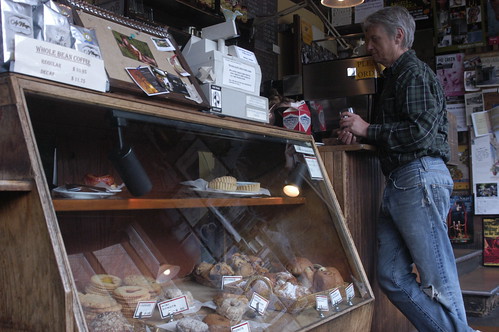
It's Not Just a Bagel

Bear with me folks, I've been sitting on this article for a while. Food and gas prices are still high, so consider this when you go to a cafe next...

International trade disputes , famine, and droughts have brought food production to the forefront of global consciousness. Gas prices remain high, and senators continue to call for approval of off-shore drilling.

These problems may seem far-flung, but local cafes and bakeries have noticed too. Wheat product and fuel prices are affecting business relations in surprising ways as local companies adjusts to the price increases.

The U-District's Cafe Allegro decided to change bagel suppliers when their original supplier — Noah's Bagels, a national chain — added a $15 delivery surcharge on top of earlier bagel hikes.

"It would have more than doubled the cost," says Chris Peterson, Allegro co-owner, explaining that they only order $12–$15 of bagels per order. "I think they just decided that wholesale bagel sales were not profitable."

Cafe Allegro now buys from Blazing Bagels, distributed without surcharge by Little Rae's bakery in Rainier Valley — at less than half the cost of Noah's.

Cafe Solstice, also in the U-District, switched from Noah's Bagels to Bagel Oasis, distributed by Essential Baking.

A couple of weeks ago Bulldog News & Espresso, the tiny espresso stand operating out of Bulldog News on University Way, stopped buying bagels all together. Barista Arielle Kloss says there wasn't enough demand to keep buying their usual 10–15 bagels from the Seattle Bagel Deli.

"It's hard, it's very hard," says Dennis Ballen, owner of Blazing Bagels in Redmond. "Gas is killing us." His business had to raise the price of their bagels in March, when wheat futures spiked and the cost of a 50-lb bag of flour nearly doubled to about $24. Ballen says his bakery has been able to deal with rising flour prices, but it's the gas that really worries him.

Fuel costs are pinching Blazing Bagels and other bakeries who distribute their own product as their wholesale distributors add or increase delivery surcharges. Ballen noticed one day that the surcharge for one delivery had jumped from $1.50 to $6 an increase he says really builds up because he receives several shipments a week from several different suppliers.

Ballen has tried not to pass it on to his wholesale customers — he delivers anywhere in the Puget Sound area for $1.50 — but at this point, “The more companies that want to distribute my product, the better," he says.

"A lot of small bakeries go out of business because of the distribution. It can really hurt ya," observes James Morse, owner of Little Rae's, a bakery that distributes Blazing Bagels. Morse says when he tried to add a delivery fuel charge a few months ago, "people didn't really like it and accused us of being a part of OPEC."

Morse doesn't quite understand why Noah's increased their prices so much, explaining, “the bigger you are, the easier it is to keep your cost down.” He says smaller bakeries have to strategize to reduce costs.

“One thing we have a good system for, is we do our deliveries in the middle of the night. We get to move freely throughout the night,” Morse reveals, which serves the double purpose of avoiding traffic and getting bagels there early in the morning. Blazing Bagels delivers then too, from 1am-7am in the morning.

Not all of Noah's customers have switched, however. The owner of Cafe on the Ave, Song, who did not give his last name, says that he debated changing vendors a few months ago after a 10–15 cent price increase per bagel, but in the end decided not to.

"I'd rather carry Noah's because their quality is better," Song explains. He accepts the delivery surcharge too, pointing out that other distributors just incorporate the cost of fuel into their product prices, instead of keeping it separate.

Song says that he and other cafe owners are trying hard not to pass the buck on to their customers, but at some point they'll have to.

“Historically, we have never had to [make] two price increases in a year,” says Anna Li, Director of Sales and Marketing for Essential Baking, which bakes pastries and distributes for Bagel Oasis. Essential is particularly vulnerable to price hikes because of their commitment to organic flour and biodiesel, which are at least 50 percent more expensive than regular flour and gas.

Li sees both businesses and individuals adapting to increasing costs, and that means finding ways to work smarter, not just pass the hikes down the line.

"I think honestly, it’s just an adjustment,” Li contends. “Americans are very lucky to spend so little on their food.”

Presidential- Sweet!

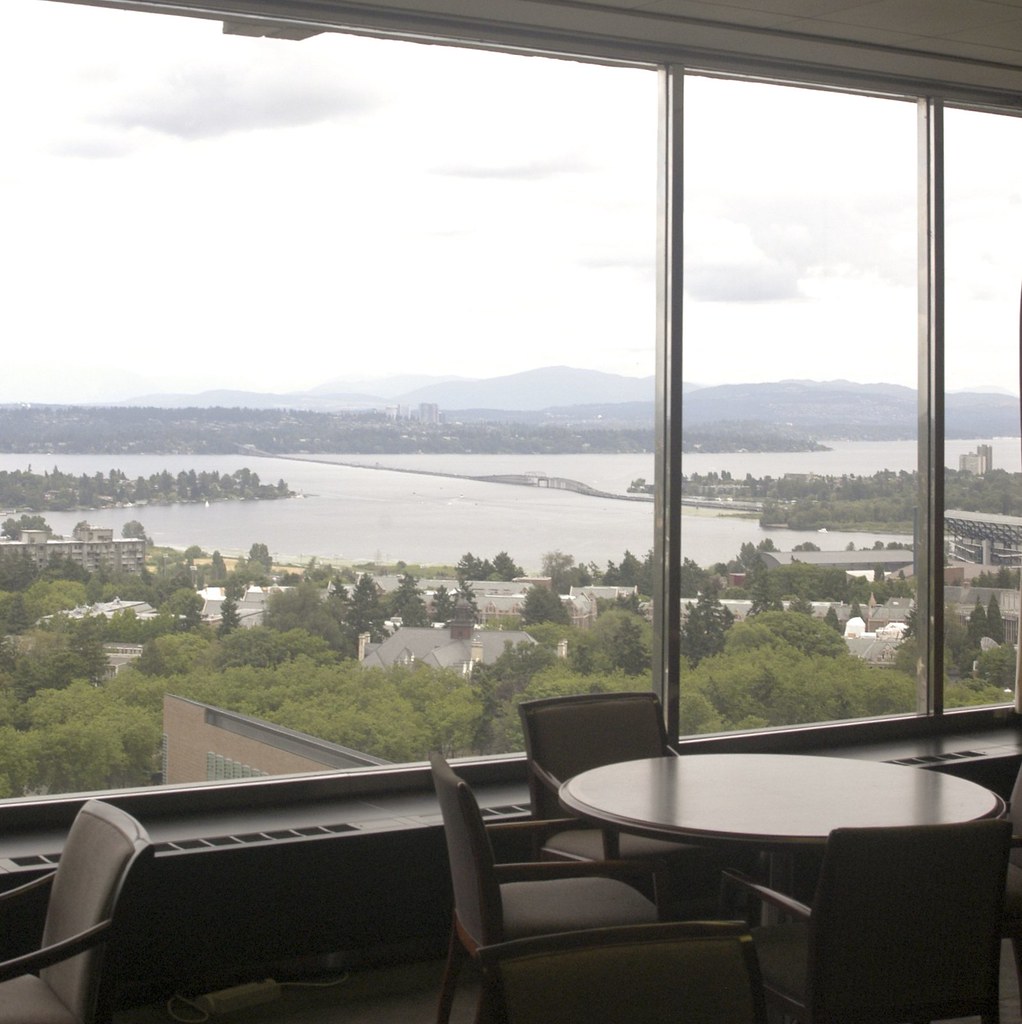
Ever wonder what kind of view the President of the University of Washington gets?
Well wonder no longer folks, cause here it is:

Yup, that's SR-520 and a corner of the Husky Stadium. I bet he can see the Cascades on the right day too. Well, he will be able to, when he moves in.
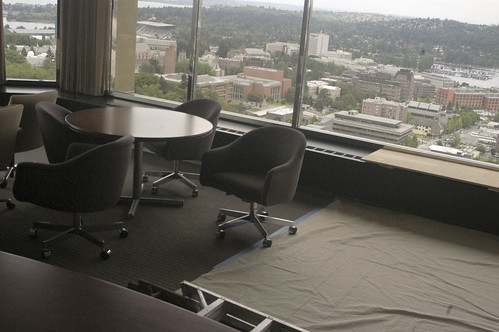
These pictures were taken from the 22nd floor of the newly christened University of Washington Tower, formerly the Safeco Tower.
The building is still under construction in some places and the 22nd floor is mostly desks, chairs, and empty cubicles. The building hints at the grand company Safeco Insurance once was. Wood panels cover the walls, floor-to-ceiling windows line every floor, and the lobby has a two-story tall ceiling.

The school bought the building in September of 2006 for $130 million along with a few other properties, like the parking lot that used to house an IHOP at Northeast 44th Street and Brooklyn Avenue Northeast.

The southwest corner of the 22nd floor faces towards an complex urban landscape with crisscrossing veins of transit. The University District's Sound Transit station was to be built near the tower, but it will instead be built near Husky Stadium.

Liberty Mutual, an insurance firm based in Boston, bought locally owned Safeco Insurance in April of this year. Despite the merger, Safeco CEO Paula Reynolds said that Safeco Field will retain it's name "for some time to come" in a July 29 article in The Seattle Times.

Tuesday, July 29, 2008

Green Behind City's Styrofoam Ban

It may appear that the City Council's bill to ban styrofoam and plastic utensils from food service businesses has an environmental basis, but a "fiscal note" linked at the bottom of the bill reveals other justifications.

It cites an annual cost of $620,ooo to the city for "collection, recycling, disposal and litter cleanup for the disposable food service items." The note also mentions that compostable containers would remove the need to sort food service garbage, which is expected to save the city money.

Not to mention the $250 fine for any establishment failing to comply.

However the City is also willing to fund the transition to the more expensive containers, which it estimates to be 5 to 1o cents more than Styrofoam ones, by helping to establish buying cooperatives.

Cedar Grove Composting appears to be the City's main destination for the food waste, and may help create "logos and/or color coding so the public cannot mistake such products for others that do not meet the established standard."

Thursday, July 24, 2008

Makes You Appreciate Your Job

A group of about 20 people in dark blue uniforms stood outside Big 5 Sporting Goods at 7:30a.m this morning. Some smoked, some watched passing pedestrians, all looked a little bored.

A man sat on a chair just inside the entryway, as if guarding the place from a mob of employees politely waiting for the signal to attack.

One older man in thick-rimmed glasses and a dark blue polo embroidered with a small "WIS" logo explained that they were counters.

Counters? I asked. Inventory counters, he answered. They are part of an international corporation of merchandisers —
WIS International, to be exact — and they would count each and every piece merchandise in the store today, including the fish hooks.

By 11a.m. the counters were gone and regular customers were the only ones examining sporting goods.

Apparently Big 5 — and other big retail stores like Wal-Mart, Walgreen and Home Depot — have companies like these perform physical counts at least once a year to check their actual inventory against their computer systems.

According to Hoovers.com, WIS International employed 7,000 and made an estimated $349 million in sales with more than 200 offices on four different continents. The company is a subsidiary of American Capitol, an investment firm with an annual sales of $700 million, headquartered in Bethesda, Md.

Counting positions for WIS are on practically every internet job-search Web site. It's almost surprising that such a labor-intensive job is still around with all of the technology these days, but that's just what the company profits on — the inconsistencies between real life and its digital counterpart.